


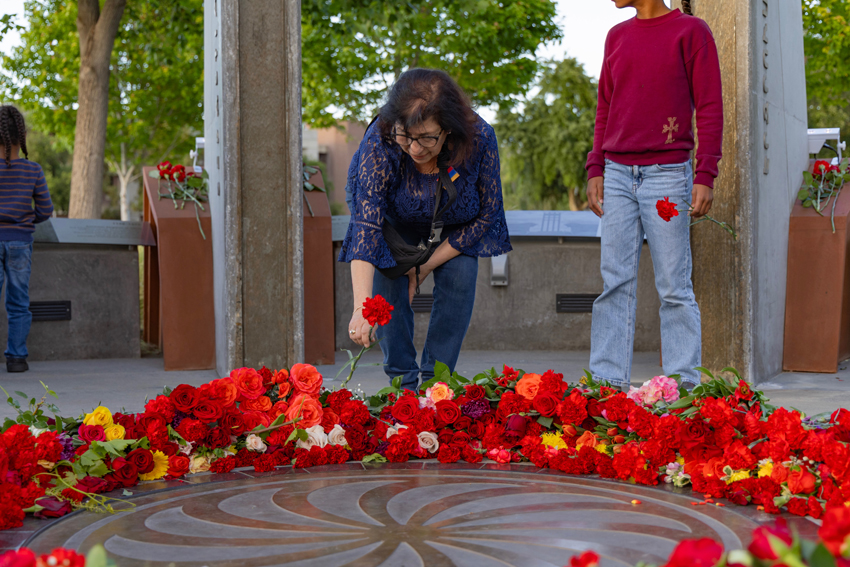
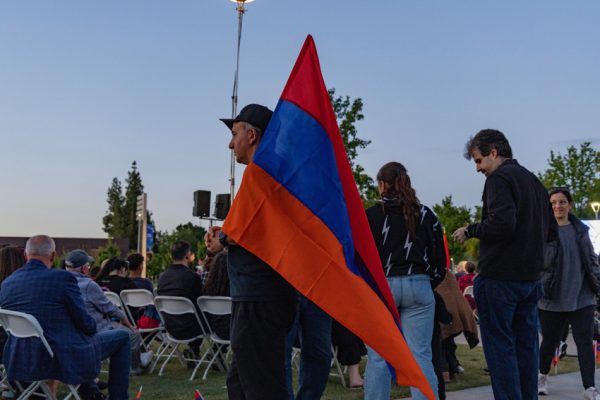
The powerful sound of the Armenian national anthem fills the Fresno State campus as a girl scout from the Homenetmen Fresno Sassoon Chapter belts the emotional melody on the evening of April 24. Many community members participate in the annual “laying of the flowers,” a beautiful and solemn tradition. People of all ages line up and carefully place crimson and orange flowers in a circle around the Armenian Eternity Symbol on the ground inside the Armenian Genocide Memorial. Most attendees wear clothes displaying the Armenian flag or carrying flags of their own.
A peaceful sadness descends on the campus as tears spill and flowers are laid. Hundreds of Armenians gathered to commemorate the Armenian Genocide and all who were lost in the tragic events of 1915.
Silva Emerian, who is from an Armenian family, works as the office manager for both middle school and high school at Fresno Christian. Emerian and her son James attended the event at Fresno State and were moved by the true sense of unity among the Armenians in the Central Valley.
“The genocide commemoration at Fresno State was a meaningful time of remembering our martyrs and coming together as a community,” Emerian said. “We don’t want to live in the past, but we remember to honor our grandparents and great-grandparents. I’m so thankful for our ancestors who leaned on their faith through the greatest suffering and passed it down to younger generations.”
Before 1915, the Armenian people were minorities within the Ottoman Empire, which was dominated by Turks who practiced Islam. As Turkish nationalist movements grew during the late 1800s, they posed more danger to ethnic and religious minorities like Armenians.
“The Armenian people have made their home in the Caucasus region of Eurasia for some 3,000 years,” stated History.com. “For some of that time, the kingdom of Armenia was an independent entity: At the beginning of the 4th century A.D., for instance, it became the first nation in the world to make Christianity its official religion.”
Armenian political parties were established to combat the rising discrimination against Armenian vulnerability. The creation of opposing parties contributed to the bad blood brewing between Armenians and Turks.
Tensions peaked with the Hamidian massacres that occurred from 1894-1896. Hundreds of thousands of Armenians were killed in what many consider a trial run for the genocide.
Another wave of massacres occurred in 1909 under the Young Turk government, which showcased the tensions that had culminated for decades.
The Committee of Union and Progress, a.k.a. The Young Turks were a nationalist party that led the Ottoman government. World War I created chaos, which perfectly set the stage to carry out the genocidal plan to destroy the Armenian population within the Ottoman Empire.
The arrest of 250 Armenian intellectuals on April 24, 1915, marked the beginning of the worst period in Armenian history. On this day, the Turks began the systematic decimation of the Armenian people, effectively killing almost the entire Armenian population within the Ottoman Empire. The lives of over a million and a half Armenians were changed forever, for the worse. This event is now known worldwide as the Armenian Genocide.
What started with disarming non-Muslims, deportations, and confiscation of property ordered by Turkish leader Talat Pasha, morphed into forced marches and massacres. Along deportation routes, the Turkish military used horrible methods to further exterminate the Armenian people.
Initially, the majority of fighting-age men were murdered to prevent revolution. The remaining Armenians were subject to mass shootings along the way to concentration camps in the desert. During marches, the elderly, men, women and children suffered through torture, extortion and murder.
Young women and girls were often raped and abducted by criminal gangs and local officials. Most of whom were killed or forced to assimilate into Turkish society.
Countless Armenians died before reaching the concentration camps. Not only were they executed, but many also died of starvation, disease, exposure, suicide and dehydration.
Before the genocide, about 2 million Armenians resided in the Ottoman Empire, and after, fewer than 500,000 remained.
What happened to the Armenian people was nothing less than a deliberate genocide, and the events of this tragedy still affect Armenians today.
David Menendian taught journalism at Clovis High School for 36 years. He engages deeply in Armenian culture by going to an Armenian church every Sunday and taking Armenian language classes with his wife.
“As an Armenian, I’ve internalized the tragedy because I saw the response of people who experienced it,” Menendian said. “By internalizing the tragedy, I have made it an incentive for me to never forget them [those who perished in the genocide].”
Three of Menendian’s grandparents came from a village in Turkey called Chomaklou. Before the genocide, his paternal grandfather, Abraham Menendian, had already found his way west of Turkey. His paternal grandmother, Ovsanna Iskenderian, was converted to Protestant Christianity when missionaries flooded into Turkey. His grandfather arrived in Manhattan in 1908 and finally settled in Visalia, California.
His maternal grandparents were both still in Turkey when the genocide began. Menendian’s grandparents, Kaghtsrig Der Nersessian and her husband Aristakes Kalfayan, boarded a boat to escape, and after being turned down many times, they ended up at the Greek port of Piraeus.
After the genocide, the Armenian diaspora spread around the world to many countries, including the United States. Many Armenians gravitated to the West Coast and settled in California. Los Angeles, Glendale and Fresno have some of the largest Armenian communities in the U.S. The Central Valley’s climate mirrors the climate in Armenia, which originally drew immigrants like Hagop Seropian to the fertile valley in the late 1800s.
Edward Soghomonian was born in 1951 in Yerevan, Armenia, which was then part of the Soviet Union. During this time in Soviet Armenia, acknowledging the genocide or having any nationalist views was brutally restricted. The Soviet Union was officially an atheist nation and strictly controlled and monitored religion.
Soghomonian, his wife, and their two-year-old daughter, Margo, immigrated to the United States in 1974, seeking religious freedom and the promise of a better life. The family ultimately settled in Fresno, California, and had another daughter, Nancy.

The Soghomonians enrolled their daughters at Fresno Christian Schools and felt blessed to be able to send their children to a Christian school, something that was unheard of in Soviet Armenia. Not only did Soghomonian enroll his daughters at FC, but he was also part of the construction of both the elementary and high school buildings.
Most of today’s youth have never heard about the Armenian genocide and the gravity of what happened 111 years ago. For Armenians like Emerian, Menendian and Soghomonian, teaching the younger generation about the tragedy of the genocide is their way of helping to prevent history from repeating itself.
“The history of the genocide is good for younger generations to know and understand because those generations can keep it from ever happening again,” Soghomonian said. “It happened. They can try to cover the truth up and say it never happened, but we know it did.”
The events of the Armenian Genocide might have happened over a century ago, but the wounds are still fresh in the spirit of the Armenian people. Armenians carry the stories of their ancestors with them wherever they go, and vow never to forget.
To read more from The Feather, visit CA High Speed Rail faces rising cost and delays or EDITORIAL: NCAA experiences major restoration to traditional values.






Jacob Dorfmeier • May 15, 2026 at 1:34 pm
I really enjoyed reading your article on the Armenian genocide, Sophia. I thought you explained the history clearly while also showing the emotional impact the event had on so many people. Your writing kept me interested the whole time because it was detailed, respectful, and easy to understand. I could tell you put a lot of effort into researching the topic, and I learned a lot from reading your article on The Feather.
Easton Baird • May 14, 2026 at 6:43 pm
Very well written
Weston Klassen • May 14, 2026 at 1:31 pm
Neat article, very proud of you❤️
Parker Collins • May 13, 2026 at 3:21 pm
This article did a great job balancing facts with emotion. I liked how it connected past events to the importance of awareness and education today. It was both interesting and eye-opening to read.
Olivia Bennett • May 13, 2026 at 3:09 pm
I thought this was a very meaningful piece to read. The writing was clear and respectful, and it helped me better understand an important part of history that is often overlooked. Thank you for sharing such an important story.
Riley Thompson • May 13, 2026 at 3:04 pm
I really enjoyed reading this article because it was thoughtful and well-written. The topic was explained in a way that was easy to follow while still showing the seriousness of the events. It’s important that stories like this continue to be remembered and discussed.
Nathan Rivera • May 13, 2026 at 1:26 pm
This article was really powerful and informative. I appreciated how it explained the history while also showing why remembrance still matters today. It made me want to learn more about the Armenian Genocide and its lasting impact.
Sornly Fema • May 13, 2026 at 11:19 am
Open news left you feeling awful remembering many survivors.
Jared Buff • May 13, 2026 at 8:12 am
Sophia, I thought your article on the Armenian genocide was very informative and well written. You explained the events clearly and included important details that helped me understand the topic better. I also liked how you showed the impact the genocide had on people and history. Your article was interesting to read and showed a lot of effort and research. Very proud that one of my classmates wrote this❤️
Aram Hovhannisyan • May 12, 2026 at 8:04 pm
So glad that we are still remembering this atrocity🥲
Colin Russo • May 12, 2026 at 5:13 pm
Nice Article 😎
Danielle Arndt • May 11, 2026 at 11:52 pm
Sophia, the intentionality and precision behind this piece truly blow me away. Keep speaking out, and I know you will accomplish great things!
Finn Marshall • May 8, 2026 at 4:31 pm
Excellent story, you go girl!👍
Curtis Vaughn • May 11, 2026 at 12:16 pm
I agree she is very talented in her journaling skills ❤️
Paul Alfonso Torres Jr. • May 8, 2026 at 4:27 pm
Very well written. Amazing story. Proud of you Sophia.
Gia Kazarian • May 5, 2026 at 1:29 pm
Beautifully written, Sophia. 👏🏻Keep shining. 💫
sara karlson • May 5, 2026 at 2:12 am
Great article – proud of you Sophia