



“Those who cannot remember the past are condemned to repeat it.”
The popular historical quote from writer and philosopher George Santayana, is often used to remind us that lessons from the past will resurface if we turn a blind eye. Do we care about what happened in the past?
I love history, more than the average teenager. The floor to ceiling bookshelf in my room contains countless books about topics that vary from Ancient Greece to the 13 colonies. My love for history started at a young age, with Percy Jackson and Hamilton fueling the fire. As someone who spends time searching for answers in historical encyclopedias, I believe that history does and will continue to repeat itself. When the past is mirrored in today’s events, how will we connect the dots? My goal is to shed light on current events through a historical lens, and make sure we are informed enough to make better decisions in the future.
Kori James teaches both AP U.S. history and regular U.S. history. She pays attention to events occurring worldwide so that she can inform her students about situations that are happening.
“Helping students make informed decisions about the world they not only live in, but will also vote in, feels more and more important each year I teach,” James said. “There is no room for ignorance in my classroom. Students learn to dig into topics and find facts other than what’s on their Tik-Tok to back their opinions.”
Current events and escalating tensions have placed a broader spotlight on history, and I’m here for it. How about the U.S. intervention in Venezuela? What does this mean in the world of foreign policy, what is foreign policy, and why are we looking back 200 plus years for our answer? Let’s find out.
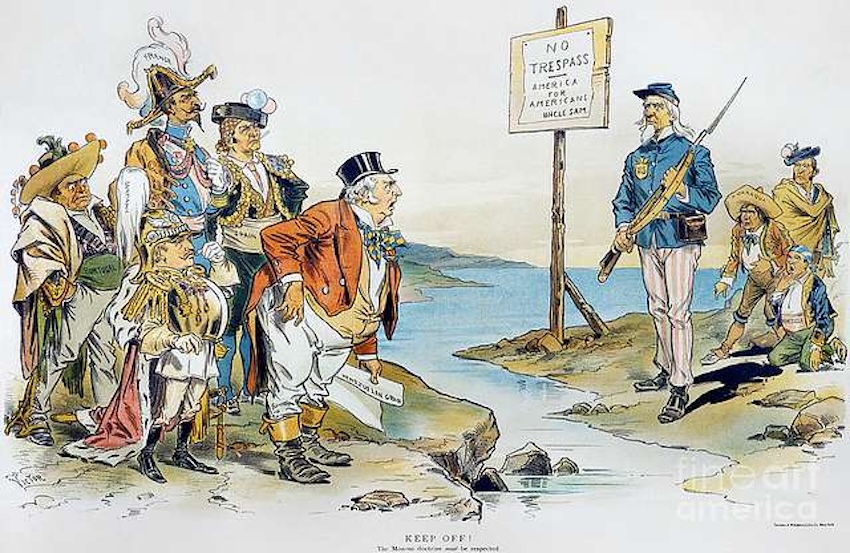
A hot topic regarding U.S. intervention in Venezuela is the use of the Monroe Doctrine. The “Donroe Doctrine” (as some like to call it), is Donald Trump‘s interpretation of the document. The “Donroe Doctrine” serves as a new take on the previous version, outlining an aggressive foreign policy approach while asserting U.S. dominance within the Western Hemisphere. Trump seeks to eliminate influence from rivals like China, Russia, and Iran through military threats, economic sanctions, and interventionism.
The original version of the Monroe Doctrine by President James Monroe in 1823 was basically a “KEEP OUT!” sign for any other nation who wanted to colonize the land that was claimed as American territory. This occurred in the heat of Westward Expansion and post War of 1812.
President Theodore Roosevelt was a key player in American foreign policy. By intervening and helping Panama win its independence from Columbia, Roosevelt expanded the reach of U.S. power into Latin America. His Roosevelt Corollary staked claim to the entire western hemisphere, and cemented America’s legacy as the protector of all its national neighbors. Sound familiar?
The question many are asking is, why are we intervening in Venezuela and is it justified? The Monroe Doctrine is more relevant than ever in this divisive subject. With Venezuela being located in the western hemisphere and our adversaries, China and Russia cozying up to Venezuelan President Nicolás Maduro, Trump made the controversial yet decisive decision to remove him from power.
Long-term success is still to be determined with our intervention, but I believe the situation has momentous short-term effects, placing both China and Russia at a disadvantage regarding resources.
This brings up many questions about creating a war to obtain resources or land or using national interest as the justification. James Polk went to war over land, William Mckinley claimed land and Theodore Roosevelt manipulated land. So how do we define success in trusting the decisions of our leaders?
Fresno Christian alumnus Tyler Maxey, ‘25, took both AP U.S. History and AP European History during his time in high school and now takes college history classes at Biola University.
“I look at political figures from the standpoint of how well they did in all three of these categories (domestic, economic, foreign policy) given the times they are in,” Maxey said, “I try to judge to the best of my ability if they were a net good or a net bad for America in how they ran the country.”
Lessons from history are like icebergs. What you see on the surface often represents only a portion of a much larger picture. With the rise of social media causing shortened attention spans, society has developed a habit of making quick assumptions about the world around us.

Using historical connections can deepen our understanding and show us what is below the surface. This helps us sharpen our ability to self-regulate what we consume and gain knowledge that allows us to make informed decisions.
When you are confused about a decision a leader makes, or a conflict or political party, look back to previous years. If you consult history, you are likely to find the answer to your questions.
My goal for this column is to write about current events in light of the past and foster more conversations, while sharing my love of history with the community. I hope you will follow along.
For more from The Feather check out Athlete Spotlight: Bryce Smith recieves football All-American or Meghan Connolly breaks school record.




Tori Tarlton • Feb 5, 2026 at 10:49 pm
Sophia!!! You are so amazing!! I am so beyond proud of you and I can not wait to see all that is to come with your writing in The Feather!! Keep working hard girl! Love you lots
Haley • Feb 5, 2026 at 4:04 pm
Very well-articulated, Sophie! Our collective memories are indeed short, but I agree with your sentiment regarding the importance of considering current events through a historical lens to better understand their significance.
Desiree • Feb 4, 2026 at 7:25 pm
Sophia, I love how you highlight the importance of looking to history to better understand today’s world and make informed decisions. Your passion for history and your goal to spark meaningful conversations really shines through. Wonderful writing young lady! I’m so excited to follow along with your future columns!!
Nanci M. • Feb 4, 2026 at 2:58 pm
Great article…
Well written and insightful!