


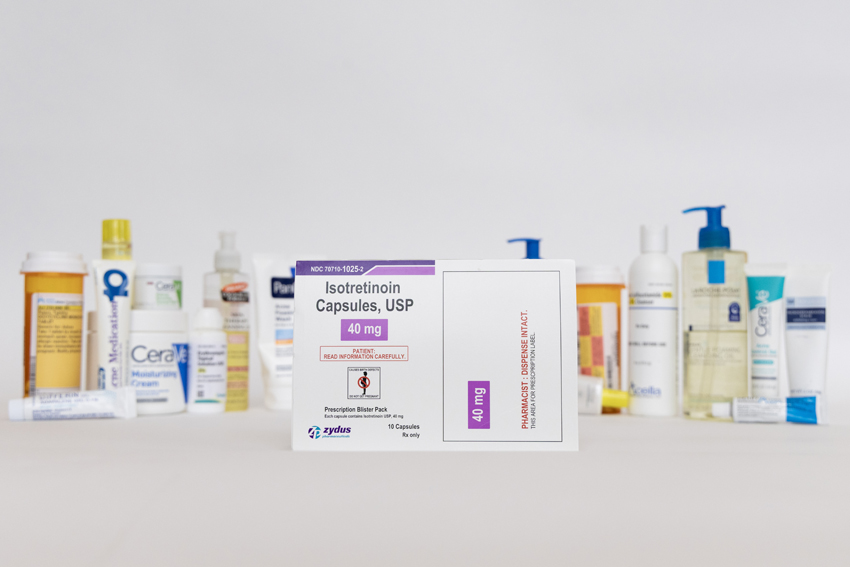
On the day before a new school year starts, you are going through your entire closet just to decide on what to wear, packing your backpack and debating what to have for lunch that day. You walk into the bathroom, look in the mirror, and bam, your worst nightmare appears: a new acne breakout on your face. Regardless of the countless steroids, creams, ointments, antibiotics and pills, teens still struggle with acne. Oftentimes, the final resort is Isotretinoin, commonly known as Accutane.
I have dealt with acne since I was 12. I went to my first dermatologist in eighth grade, and now I am 18 years old, a senior in high school. I have taken so many skin drugs already, one round of Accutane, and am now seeking a second. Acne is a deep insecurity for many people, including myself.
How Accutane works is by shrinking oil glands, reducing the number of triggering bacteria, preventing clogged pores by speeding up skin cell turnover and decreasing inflammation. I would recommend taking Accutane with caution.
I was a freshman in high school when I decided to take the drug. I was tired of putting on five or six skin treatments everyday, along with taking two oral antibiotics. I wanted a solution. My sister had taken the drug, so I knew mostly what to expect. Accutane, for me, was not a severe medication. I had very dry facial skin, lips and sunburned easily, but that was the extent. The most severe part for me was having open, wound-like cracks on the sides of my lips. Finding a good moisturizer, sunscreen and chapstick was key.

Due to my dry skin during treatment, I could not wear any makeup besides mascara. The facial makeup would simply flake off or noticeably crack. One tip that I would give to someone considering Accutane is to align the beginning of your treatment with summer break. That way, you do not have to be concerned with seeing peers at school when your acne is at its peak. Another reason is that during the summer, you are outside sweating a lot, so makeup is not necessary. You have to be diligent about sunscreen, though.
When I finished my course of treatment in 2023, I felt amazing; I had no breakouts or scarring. However, I started experiencing acne relapses about a year later. I was so frustrated that the Accutane had not worked long-term, so back I went to using other treatments like doxycycline and tretinoin. Tretinoin was so harsh on my skin that it would actually burn me. Now, three years after my first round of Accutane, I am seeking a second. Needing more than one round is not totally uncommon, but irritating.
According to the National Library of Medicine, 70-80% of people do not need a second round of Accutane, like senior Benson Elbert. Elbert’s course of treatment lasted a year and a half.
“Accutane was my last-ditch effort to get my acne under control,” Elbert said. “My skin underwent massive improvement on my face and shoulders, a night-and-day difference to what it used to be. If a close friend wanted to take Accutane, I would say that starting it is a big commitment and results will not be immediate.”
In a recent study by ClinCalc in 2021, 1,199,278 prescriptions of Accutane were distributed to 473,970 patients in the United States alone. This drug is popular among teens and young adults who have a hard time troubleshooting persistent acne.
The drug is not an over-the-counter medication; it takes multiple steps to even be considered a proper candidate for the drug. Dermatologists oftentimes make patients try multiple other ways to get rid of acne before prescribing Accutane. Treatments are usually over-the-counter ointments like benzoyl peroxide, then prescription antibiotics, including tretinoin, adapalene, or tazarotene. If those do not work, the doctors can prescribe oral antibiotics like doxycycline or minocycline.
The process can be rigorous and painful for many. After trying multiple solutions, that is when doctors prescribe Accutane (differs for all patients). Treatment consists of taking one oral pill per day, dosage varies per patient, for about six to nine months.
Accutane is a derivative of Vitamin A, which our bodies naturally produce. It is a much stronger dose with the chemical makeup of C₂₀H₂8O₂.
Doctor Sandra Lee, also known as Dr. Pimple Popper on TLC, has been a practicing dermatologist for over 20 years and is based in Upland, CA, providing acne and skin treatments.
“Isotretinoin is a powerful oral medication used to treat severe nodulocystic acne, those deep, painful and often scarring breakouts,” Lee said. “Interestingly, Accutane was initially developed as a chemotherapy drug. It was approved by the FDA for cystic acne treatment in the 1980s.”
All patients have to enroll in the FDA’s iPledge program and complete a quiz every month to show their knowledge about the risks of the drug in order to obtain their next Accutane prescription.
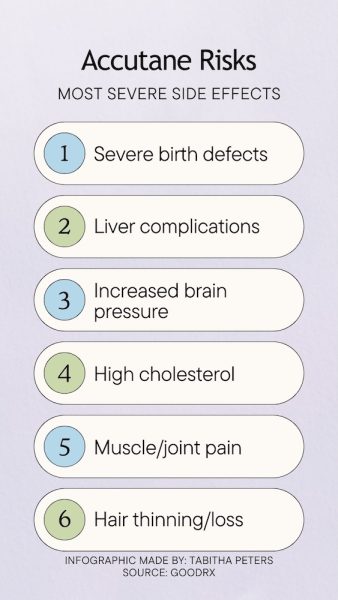
Doctors make patients extremely aware that it is not okay to be pregnant or planning during the course of treatment. Taking Accutane during or before pregnancy causes miscarriage, premature birth and severe birth defects affecting a baby’s brain, heart and face. This is why patients are required to fill out iPledge, take pregnancy tests and get bloodwork done regularly.
Many are asking: Is Accutane worth it or not? Senior Kennedy Schwab started treatment two months ago and has experienced side effects such as consistent nose bleeds and back pain.
“I would say the benefits are worth the side effects,” Schwab said. “For me, my skin has definitely gotten worse before better. I am slowly starting to see the clear skin results, and it really does give me more confidence the clearer it gets, but it is for sure a challenge to get to that point.”
Accutane is a very personal journey tailored to each person taking it. If you are considering the drug, talk to a licensed dermatologist.
For more in columns, visit Column: History on replay: Sophia Feldkamp compares then and now.
For more from The Feather, visit California Voter ID Petition sparks debate or 2026 movie lineup invokes enthusiasm.









Catherine Peters • Feb 12, 2026 at 12:05 pm
Excellent article, Tabitha! Your facts and personal experience were conveyed very well, throughout. I’m sure all students will be able to relate to your article.
Garrett Alvis • Feb 12, 2026 at 11:05 am
Great job Tabitha, acne can be such a confidence struggle for teenagers. Thank you for putting a spotlight on opportunities for others to get help.