


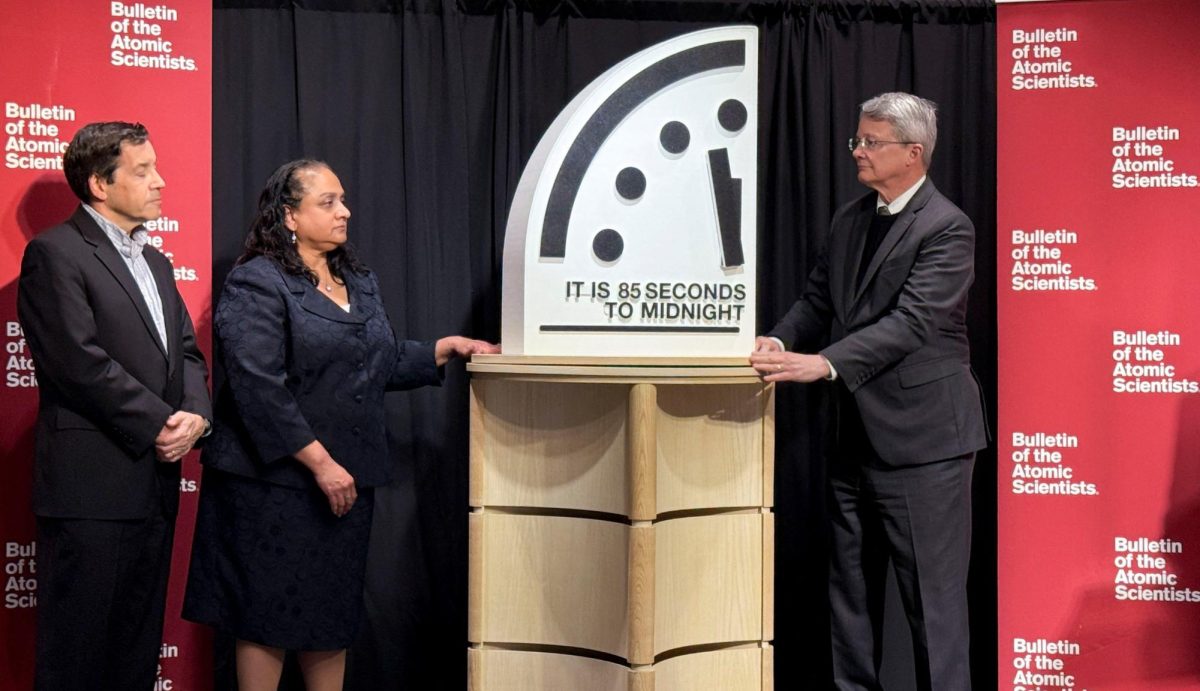
Humanity is closer to destruction than it has ever been, according to The Doomsday Clock, a symbolic representation created to show the direct impact of human action on the world, counting down to catastrophe. On Jan. 27, amid ongoing conflicts and geopolitical tensions, the Doomsday Clock was set to 85 seconds, the closest it’s ever been to midnight since its inception.
The Bulletin of the Atomic Scientists’ Science and Security Board who sets the clock annually, urged global officials to reduce nuclear arsenals, establish international rules in response to the rapid growth of artificial intelligence, geopolitical instability and strengthen collaborative efforts to address global biological threats such as climate change.
Joseph Davila, ‘27, says it’s scary that we even live in a world that needs something like the Doomsday Clock.
“To me, Doomsday is the metaphorical end of the Earth being livable,” Davila said. “The fact that humanity can’t come to an agreement on doing what’s best for the Earth is honestly disturbing.”
President and CEO of the Bulletin of the Atomic Scientists, Alexandra Bell, is a noted policy expert and diplomat overseeing the management of the Doomsday Clock. She has a decorated background, previously serving as deputy assistant secretary for nuclear affairs in the U.S. State Department’s Bureau of Arms Control.
In an interview with Reuters, Bell expressed concerns over the lack of cooperation between global nations on matters of mass destruction and the incorporation of artificial intelligence into military systems and the misinformation around the world through the application of AI.
“Of course, the Doomsday Clock is about global risks, and what we have seen is a global failure in leadership,” Bell said. “In terms of nuclear risks, nothing in 2025 trended in the right direction…Catastrophic risks are on the rise, cooperation is on the decline, and we are running out of time.”
The clock was created in 1947 by theoretical physicists Albert Einstein, Robert J. Oppenheimer and other members of the famous Manhattan Project as a way to convey the dangers posed by the nuclear threat after WWII. Once the clock ticks to midnight, the devastation caused by humanity’s negligence becomes irreversible. The clock is not a prediction to a specific event, instead a dire warning of global safety based on scientific analysis and census.
When looking back, what historic events make you think of Doomsday? Here are some major changes in the timeline:
The Clock Starts Running 1947 – 7 Minutes
The Bulletin of the Atomic Scientists Doomsday Clock was invented after artist Martyl Langsdorf conceptualized a magazine cover designing the now-known symbol.
The Arms Race 1949 – 3 Minutes
In a remote site in Central Asia, a Soviet Union nuclear device similarly designed to the one the United States dropped on Japan went off, Soviets denied the test’s existence. U.S. President Harry Truman shared the news to the American public, leading to the beginning of the arms race.
The Horror of Hydrogen 1953 – 2 Minutes
Against the opposition of nuclear scientists, the United States pursued the hydrogen bomb, a Nuclear weapon far more powerful than the previously used atomic bomb. In 1952, the United States tested its first thermonuclear devices in the Pacific Ocean. This led soviets to develop an H-bomb of their own nine months later. The reality of such weapons of destruction created mass fear. Bert the Turtle was a direct product, a cartoon commercial teaching young kids the “Duck and Cover” method in anticipation of a nuclear attack.
Cooperation, not Confrontation 1960 – 7 Minutes
For the first time, the United States and the Soviet Union seek to avoid direct confrontation in regional conflicts, joint projects to build trust and dialogue between third parties to help hostilities.
A Rest from Tests 1963 – 12 Minutes
After the tension of the near-catastrophic Cuban Missile Crisis, a Partial Test Ban Treaty was signed, ending all atmospheric nuclear testing. The test did nothing to outlaw underground testing but represented the first instance of progress in slowing the arms race, working together to prevent nuclear annihilation.
The Eastern World Explodes 1968 – 7 Minutes
While world governments waged the Cold War, hotter wars raged in Asia. The United States involvement in Vietnam intensified, along with India and Pakistan fought over Kashmir in 1965. Israel and its Arab neighbors renewed hostilities in 1967. France and China developed nuclear weapons to assert themselves as powerful global players.
A Landmark Agreement 1969 – 10 Minutes
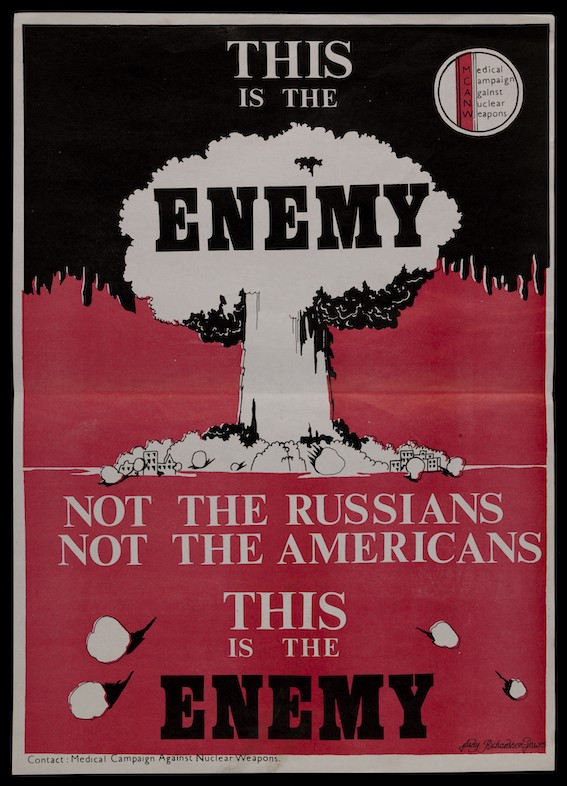
1980s Medact
Nearly all of the world’s nations came together to sign the Nuclear Non-Proliferation Treaty. This deal had nations that already were producing nuclear weapons vowing to help other signatories develop their own nuclear power if they promised not to produce any further weapons.
Passing the SALT 1972 – 12 Minutes
After more than 20 years of competing for arms, the United States and Soviet Union signed two treaties in attempts to end the race for nuclear superiority. The Strategic Arms Limitation Treaty (SALT) limits the number of ballistic missile launchers either country can possess.
India Joins the Club 1974 – 9 Minutes
India tests its first nuclear device any previous arms control seems as if a fantasy and the U.S. and the Soviets modernize their nuclear forces.
Accelerating drift towards world disaster 1980 – 7 Minutes
The SALT treaty negotiations between the U.S. and the Soviets remain unfruitful. Both parties are behaving in what’s best described as ‘nucleoholics,’ their obsession with the weapons of destruction on an undeterred path.
Reheating the Cold War 1981 – 4 Minutes
The Soviet invasion in Afghanistan in 1979 and the 1980 election of Ronald Reagan in the United States hardened the U.S. nuclear posture. Before leaving office, President Jimmy Carter pulled the United States from the 1980 Olympic Games in Moscow. Reagan intensified the posture that the only way to end the Cold War is by winning it.
Stalemate and Star Wars 1984 – 3 Minutes
U.S.-Soviet relations reach a halt without any channel of contact, communication turns into propaganda and the United States threatens to provoke a new arms race seeking a space based anti-ballistic missile system.
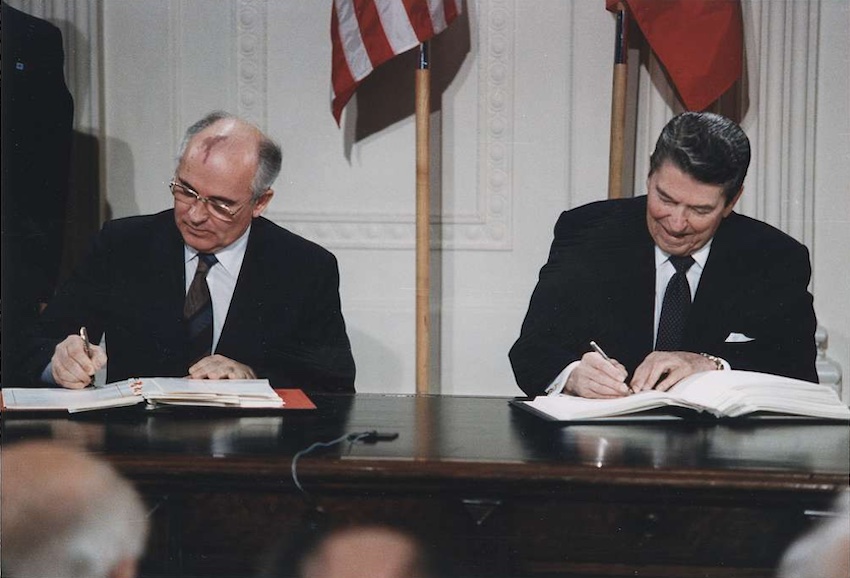
Protests Yield Progress 1987 – 6 Minutes
At the end of 1987, the United States and Soviet Union signed the historic Intermediate Range Nuclear Forces Treaty, the first agreement to actually ban a whole category of nuclear weapons.
Lowering the Iron Curtain 1990 – 10 Minutes
The fall of the Berlin Wall in late 1989 symbolically ended the Cold War. One Eastern European country after another overthrows Soviet-backed government, with the Bulletin board writing, its the end of communism.
A Fresh Start 1991 – 17 Minutes
In 1991, with the cold war officially over, the United States and Russia began making heavy cuts to their respective arsenals. U.S. President George H.W.Bush and Soviet President Mikhail Gorbachev signed the Strategic Arms Reduction Treaty. This led the board to set the clock back to 17 minutes, the longest time until midnight in the measurement’s history.
A Close Call 1995 – 14 Minutes
The year begins with the Russian military mistakenly identifying a U.S.-Norwegian scientific rocket for a nuclear missile and Russian President Boris Yeltsin decides whether to launch a nuclear attack, raising tensions over the post-Cold War world. 40,000 nuclear weapons remain worldwide.
South Asia’s Nasty Surprise 1998 – 9 Minutes
Fourteen years after joining the ranks of countries with nuclear weapons, India carried out nuclear tests that caught the U.S. Intelligence off guard. This raised worldwide outrage and tensions rose after Pakistan held its own set of nuclear tests. 7,000 combined weapons aimed at each other between the United States and Russia.
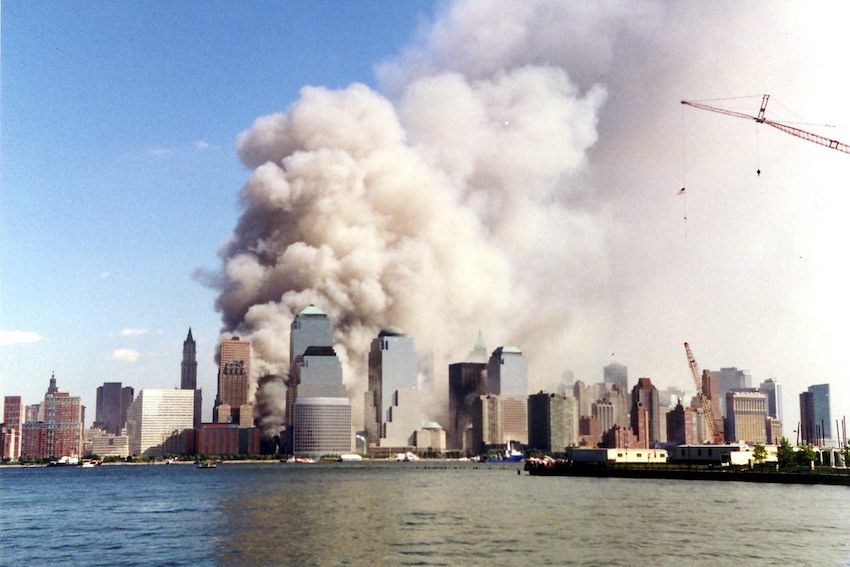
New Worries, New Weapons 2002 – 7 Minutes
After the Sept. 11, terrorist attacks, the United States expressed increasing concerns about nuclear weapons falling into the wrong hands. A major concern is the enormous amount of unsecured and unaccounted for weapon-grade nuclear materials throughout the world.
North Korea Rising 2007 – 5 Minutes
North Korea conducts a nuclear test, the international community worried that Iran was working on its own bomb. The United States and Russia remain ready to wage nuclear war.
Hope after Copenhagen 2010 – 6 Minutes
United Nations climate change conference in Copenhagen. Both industrialized countries agree to take responsibility for carbon emissions and to limit global temperature rise to two degrees Celsius.
Desperately Seeking Solutions 2012 – 5 Minutes
Lack of acknowledgement from global leaders on nuclear weapons and climate change.
Failures of Leadership 2015 – 3 Minutes
Despite positive developments in the area of climate change, the efforts are entirely insufficient to prevent a catastrophic warming on Earth. While further global powerhouses continue to modernize nuclear technology.

100 Seconds to Midnight 2020 – 100 Seconds
Humanity continues to fight two polarizing dangers of climate change and nuclear war, while cyber-enabled warfare runs rampant, leading to an information warfare undercutting society’s ability to respond.
90 Seconds to Midnight 2023 – 90 Seconds
The clock advances to 90 seconds to midnight, reflecting increased global instability and the war in Ukraine.
89 Seconds to Midnight 2025 – 89 Seconds
National leaders and their society have failed to do what is necessary to change course from disaster. AI becomes involved in humanity’s everyday life with a lack of restrictions or laws.
2026 – 85 Seconds
The clock moves to 85 seconds to midnight, the closest it has ever been, citing nuclear risk, climate change, emerging technologies and weakened international cooperation.
As time continues to tick down, nations grow further apart, societies crumble with internal quarrels and the threat of human annihilation reaches an all-time high. It’s important to remember that the clock is a symbolic representation of humanity’s potential destruction, not a solidified death date. By working together, we can turn back time.
For more from The Feather read Column: History on replay: Sophia Feldkamp compares then and now or Athlete Spotlight: Bryce Smith receives football All-American.