


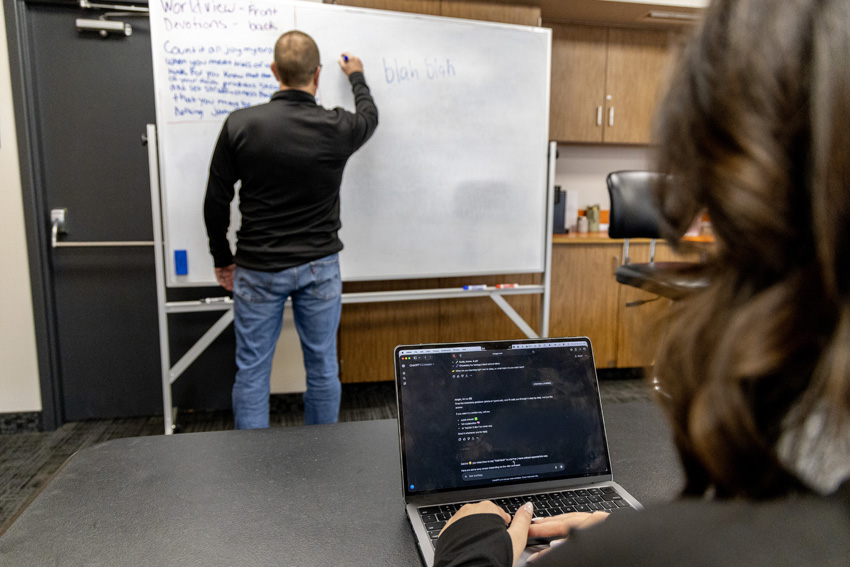
Have you ever come across a video while scrolling through Instagram and thought to yourself, “There is no way someone actually did this,” only to find half of the comments saying it is Artificial Intelligence? Digital integrity is a common problem across all aspects of content creation: music, writing, memes, art, photography and so much more. Often, the difference between real and generated content is almost imperceptible, and what is worse, sometimes people’s actual hard work and dedication are condemned as AI-generated.
It will not take long before AI becomes indistinguishable from actual work in many fields. AI has already improved exponentially from where it started a decade ago; if given another decade, not many people will be able to tell the difference between what is real and what is fake. Social media platforms are the No. 1 platform for news consumption in the U.S., making it critical to confirm that the things we see are not AI-generated.
The topic of ethical use of generative AI goes much deeper than what’s real or fake. Society needs to look at how early AI has been destructive in fields such as art, literature and writing.
The art industry has been absolutely devastated by generative AI for many years, being the first and most disrupted industry to face ramifications of AI. The situation is so dire that a term used satirically in 19th-century France is being applied to today’s world; the term “starving artist” refers to people who suffer a life of poverty in order to pursue a creative profession or passion. These individuals have sacrificed financial stability to pursue their aspirations and passions for art, and we, as a society, have turned our backs on them in favor of cheaper options.
View this post on Instagram
Now the issue is starting to spread like a disease. The creative department suffered its fate, and now it is everyone else’s turn. In the computer and electronics field, RAM hardware prices have increased by over 400% in the last 18 months. Electronic parts that cost barely a hundred dollars in 2024 are nearing almost $500 in 2026. People who obtained their Computer Science degrees a few years ago are having to work entry-level jobs just to avoid homelessness; the thought process now is, why bother with a degree when all you need is to learn a program?
It can take upwards of 500ml of water for engines like ChatGPT to answer a single question; apply this to millions of users, and you have a water consumption cost of approximately 39.16 million gallons of water, and an energy cost of approximately 39.98 million kWh (kilowatt-hours) each day.

The same water used to cool AI data centers is the same clean water we use for drinking, cleaning and extinguishing fires.
How do we utilize AI while also respecting those who dedicate years to their passions? The answer is more complex and layered than just limiting what AI can do. A great way to get the best of both worlds is to use AI strictly as a tool and resource while keeping it out of the final project. If you’re struggling to create artistic work, use AI as a last resort to reference the pose and angle, but don’t allow it do the whole product to publish immediately. If you’re stuck on a chapter you’re trying to write for your novel, ask AI to give you ideas on what to write and change, but don’t copy and paste it directly into it. It is important to keep in mind that anything a search engine like ChatGPT comes up with is trained from somewhere else, resulting in indirect plagiarism.
Pay artists for their hard work, support musicians for their talent, appreciate writers for their creativity and praise photographers for their dedication. We as a society have failed them, but it doesn’t have to continue. Not everything needs to be solved with stolen data and gigawatts of energy. Hard work builds character, which people are starting to forget.
A study published in October 2025 discovered that the #1 use of AI is for “therapy and companionship,” while the second is for “finding purpose.” People are referring to code for emotional support, therapy, and finding a purpose in their lives. The impact of AI on mental health is rivaling the effects of when social media was first introduced in the early 2000’s. If the situation with artists somehow doesn’t concern you, then the well-being of your friends, family and your descendants should.
All of these repercussions have started to appear just within the last decade of public access to Generative AI. Already, some AI tools have become almost identical to human-made work. We need to help each other as much as possible, from emotional support to social needs and financial stability. It’s time we stopped relying on generative-AI to solve all of our issues, and instead put in the work and time to fix them together. In a world so connected and intertwined, we have never been so far apart.
To read more editorials consider EDITORIAL: Comparison extinguishes youthful contentment and EDITORIAL: Gun violence triggers awareness of fragmented society.
For more from The Feather, read New guidelines turn food pyramid upside down and Alumni reflects on his journey at Valley Leadership Academy.


Tabitha Peters • Jan 30, 2026 at 1:33 pm
Thank you to all of The Feather staff who contributed to this editorial. It is an important topic to talk about, especially in the world of journalism. Great work!